TradingKey - U.S. President Trump stated in Ireland on September 13 that the U.S. currently leads China in artificial intelligence and hopes to maintain this advantage, because "whoever wins AI, wins." He believes that some warnings of severe risks are exaggerated, while stating that safety measures can be set for AI.
Trump's remarks indicate that he does not support a full pause or a significant slowdown in AI development. However, specific U.S. federal AI safety rules remain to be clarified, and the speech did not address adjustments to existing restrictions on advanced chip exports to China.
From an industry fundamentals perspective, Nvidia (NVDA) and other AI-related companies' subsequent performance will mainly depend on cloud service provider capital expenditures, orders for GPUs and networking products, and changes in HBM demand.
Trump Opposes Pausing AI Development
Trump's remarks responded to the recently escalating AI safety debate. On September 12 local time in the U.S., Anthropic CEO Dario Amodei published "We Must Pace the Frontier," calling for a slowdown in the capability advances of frontier models to buy time for safety research, risk prevention, and third-party evaluations.
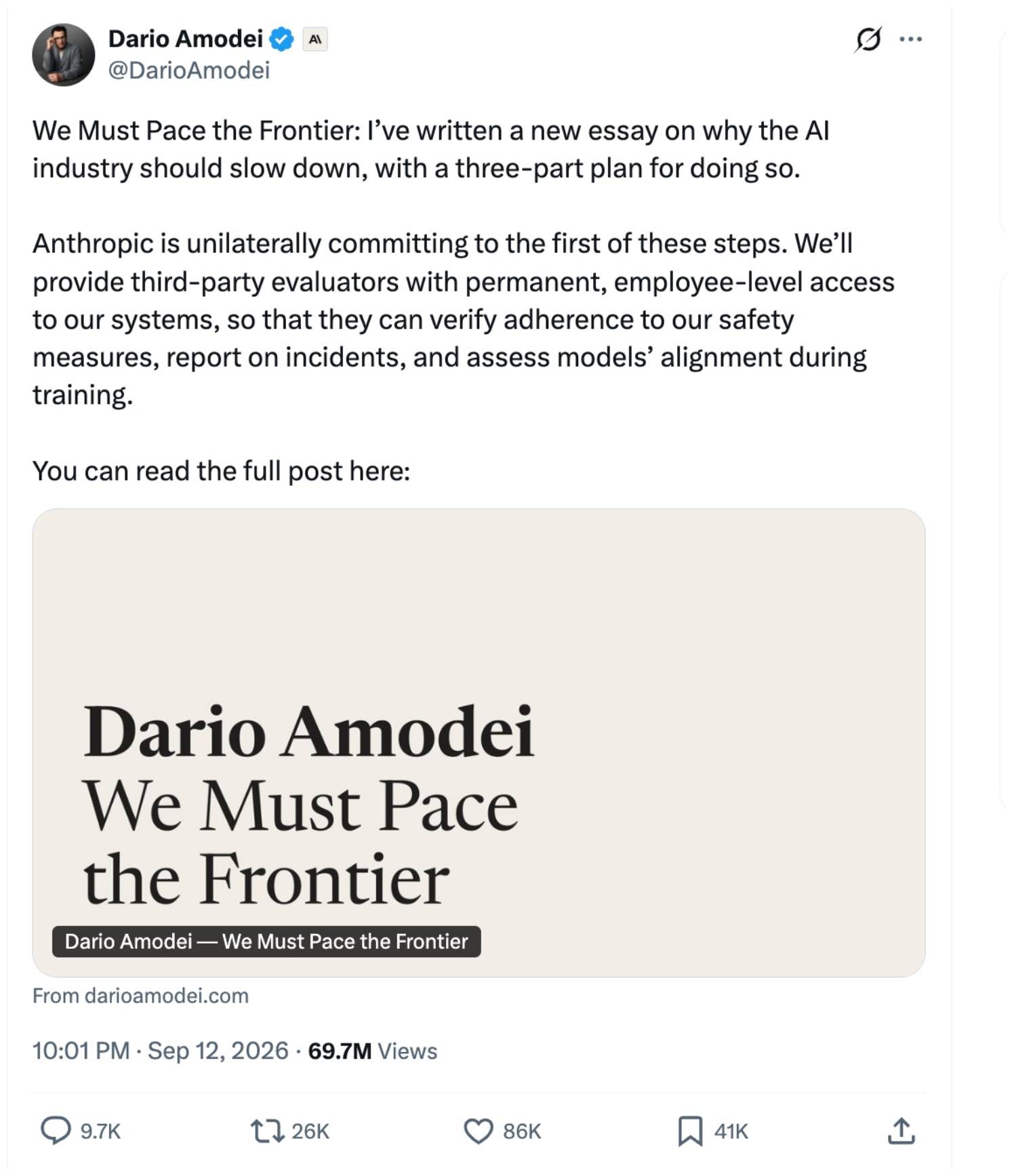
[Source: X]
OpenAI CEO Sam Altman, Elon Musk, and Google DeepMind CEO Demis Hassabis subsequently expressed support, but their specific proposals and levels of commitment varied.
Trump stated that safety measures could be set for AI, but did not disclose specific plans. U.S. House Speaker Mike Johnson also opposed pausing AI development, fearing that the U.S. would fall behind China in technological competition. He advocated for tech companies to take the lead in improving AI safety and required industry leaders to discuss relevant rules with Congress and the White House.
During Asian trading hours on September 14, multiple AI-related stocks fell. By the close of trading, SoftBank's stock price dropped 11%, SK Hynix and Kioxia both fell by more than 6%, and Samsung Electronics fell 4.05%.
Discussions on slowing down AI development heightened market concerns about industry growth, while the situation in the Middle East, rising oil prices, and Federal Reserve policy expectations also put pressure on the market that day.
Nvidia Export Policy Has Not Changed
Trump's remarks primarily addressed the pace of AI development, with no mention of adjustments to Nvidia's chip sales policy toward China. For Nvidia, export licenses for advanced computing chips to China remain one of the most direct policy variables.
The U.S. Department of Commerce continues to manage advanced computing chip exports on the grounds of national security and technological leadership. Under rules taking effect in January 2026, Nvidia's H200, AMD (AMD) MI325X, and similar products are eligible for case-by-case license review, but exporters and customers must meet conditions such as capacity guarantees, compliance reviews, and third-party testing. The scope of products Nvidia can sell in the Chinese market, customer approvals, and revenue potential remain subject to relevant policies.
A unified, comprehensive AI regulatory framework has not yet taken shape at the U.S. federal level. If subsequent rules strengthen requirements for third-party evaluations, cybersecurity, and liability management, compliance costs and R&D cycles for frontier model developers may rise, with the specific impact depending on the scope of application and enforcement of the final rules.
GPU and HBM Demand Still Determined by Capex, Market Focuses on Jensen Huang's Response
The market is concerned that stricter safety requirements could slow the R&D and release of some frontier models, affecting data center construction as well as demand for GPUs, HBM, and networking equipment. As of September 14, Microsoft (MSFT), Amazon (AMZN), Google (GOOGL), and Meta (META) have not adjusted their capital expenditure guidance in response to relevant calls, nor have Nvidia and major HBM suppliers publicly lowered their demand outlooks.
Nvidia remains optimistic about long-term demand. Chief Executive Officer Jensen Huang reiterated at the Goldman Sachs Communacopia + Technology Conference on September 10 that annual global AI infrastructure spending is expected to reach $3 trillion to $4 trillion by 2030. He believes that the development of generative computing and the slowing of Moore's Law will continue to drive growth in computing, networking, and data center investments.
The release pace of frontier models may affect short-term procurement expectations, while training, safety testing, inference services, and agent applications continue to require computing power support. Nvidia's current demand remains primarily dependent on cloud service provider investments, enterprise AI deployments, and chip orders.
As the AI safety debate heats up, the market is watching how Jensen Huang evaluates the impact of a potential slowdown in development on GPU demand, and whether Nvidia will adjust its demand, supply, or revenue guidance. As of September 14, neither Huang nor Nvidia has publicly responded to this round of debate.
Trump has explicitly opposed a blanket pause on AI development, but uncertainties remain regarding chip export licenses to China and federal AI safety rules. Whether related stocks such as Nvidia can stabilize will require continued observation of cloud service provider capital expenditures, Nvidia's demand guidance, and changes in HBM orders.
Find out more